Some problems persist not because they are inherently complex, but because we do not understand why they fail. We jump to solutions before grasping what is actually happening, or we lose ourselves searching for causes so deep that we end up digging tunnels with no exit. What we initially believed to be the cause soon appears, upon further reasoning, to be the consequence of an even deeper cause, as if part of an endless chain. Between superficiality and the abyss lies a more fertile path: a method that combines clarity, depth and creativity.
We can imagine it as a diamond shape, an ancient figure symbolising the passage between levels. Each vertex represents a different pole: division (descent), subtraction, addition and multiplication (elevation). These words function as mnemonic rules, not literal mathematical operations, but ways of orienting oneself in the process. To descend is to locate what divides; to subtract is to refine; to add is to open alternatives; and to elevate is to multiply the effect of the solution.
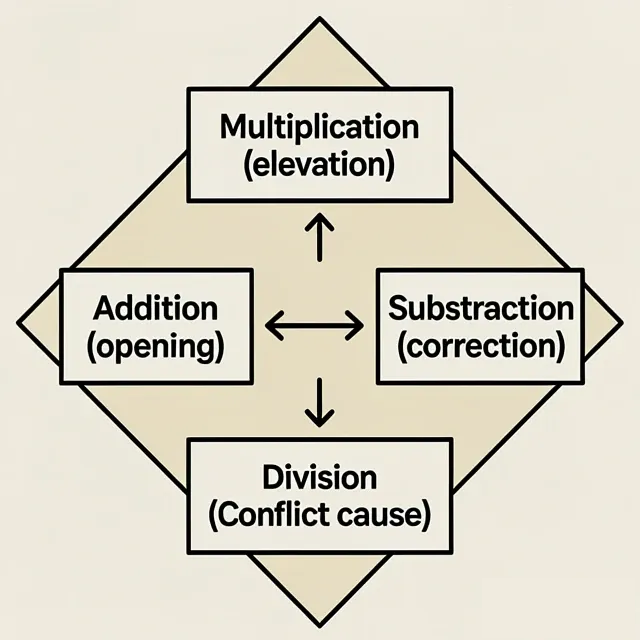
1. Descending: locating the cause that divides and generates conflict
This pole calls for the movement of questioning. Here we ask: what divides, what creates the problem, what point of friction organises the situation? Descending is not about digging without limit, but about finding the operative cause, the one that produces the symptom in the present.
In psychoanalysis, this involves an essential nuance: childhood trauma is not the ultimate cause, but the condensed effect of a logic that continues to operate today. The trauma was the densification of something subtler that still repeats itself; a mark from which the person has not yet detached. This is why the work naturally begins by travelling to the past, but does not remain there; one must understand and identify what part of that logic is still alive now.
Examples:
- Clinical: The person discovers that their reproachful reaction arises when they feel they are about to be judged. The childhood trauma was an effect; the operative cause is the current experience of evaluation as a threat.
- Social group: The conflict does not stem from the “character” of the problematic member, but from an ambiguous role that no one has defined and to which the group does not know how to respond.
- Workplace: The blockage does not arise from a “lack of motivation”, but from a poorly designed dependency between two company departments.
- Advertising: The campaign fails because the message divides the audience: it arrives at a point in the customer journey where it does not fit.
2. Subtracting: correcting what inflates the problem
At the second pole, subtraction involves correcting what, once the operative cause has been located, we know is feeding the problem. To subtract is to stop doing what worsens the situation: to interrupt an automatic ego reaction, to refrain from trying to change the other person, to set reproach aside, to avoid mechanical complaining.
In everyday life, subtracting means removing the additions that distort the scene: dramatisations, assumptions, demands, defensive habits.
Examples:
- Clinical: A person who reacts with reproaches whenever they feel insecure learns to interrupt that automatic pattern.
- Social group: The group stops responding with irony or avoidance to the conflictive member, because such responses only reinforce the pattern.
- Workplace: A team stops blaming other departments and corrects its own unproductive shortcuts.
- Advertising: Superfluous messages that confuse the audience are removed, and distracting elements are refined.
3. Adding: opening alternatives and recognising opportunity
Once the operative cause has been located and the automatisms feeding the problem have been corrected, the moment comes to add. Adding means introducing resources, opening possibilities, seeing opportunity where previously there was only repetition. It is the creative movement of the process.
In the mnemonic rule, adding means increasing: introducing elements that allow the situation to be transformed, expanding room for manoeuvre, generating options.
Examples:
- Clinical: The person learns new ways of requesting feedback, rehearses alternative responses, and discovers opportunities where they once saw only threat.
- Social group: The group redefines roles, establishes clear boundaries, or creates conversational spaces that did not previously exist.
- Workplace: Collaborative tools are introduced, workflows are reorganised, or more effective communication channels are opened.
- Advertising: The message is reformulated, new channels are explored, or a promising segment is identified.
4. Elevating: when the solution multiplies and makes the result stand out
The final movement consists in evaluating whether the solution not only resolves the issue but multiplies its effect. To elevate is to verify whether the change produces a shift in level, whether it generates a result that stands out — a product that is not merely the sum of its parts.
Just as what divides generates conflict, what multiplies generates differentiation: a more stable, broader and freer mode of functioning.
Examples:
- Clinical: The person no longer becomes overwhelmed when evaluated; they can now sustain difficult conversations without falling into reproach.
- Social group: The conflictive member ceases to be a source of tension because the group’s dynamic has shifted to a higher level.
- Workplace: The team works fluidly and the solution becomes integrated as a new standard.
- Advertising: The adjusted campaign not only works: it opens a new segment or redefines the brand’s strategy.
A cycle that repeats without stagnating
Most of the time, a single leap is not enough. Continuity is needed. Another cycle begins, perhaps with more correction or more creativity. What matters is not confusing depth with an end in itself, nor speed with effectiveness. Solving a problem is an art that combines lucidity, precision and movement.
Descending to understand division. Subtracting to correct. Adding to open. Elevating to transform and multiply.